
01
Products are difficult to compare
The same product can have a different name, item code, or description at different suppliers. This makes automatic comparison almost impossible.
Automatically connect companies, products, and locations. Improve data quality with intelligent data matching and reliable dataset connections.
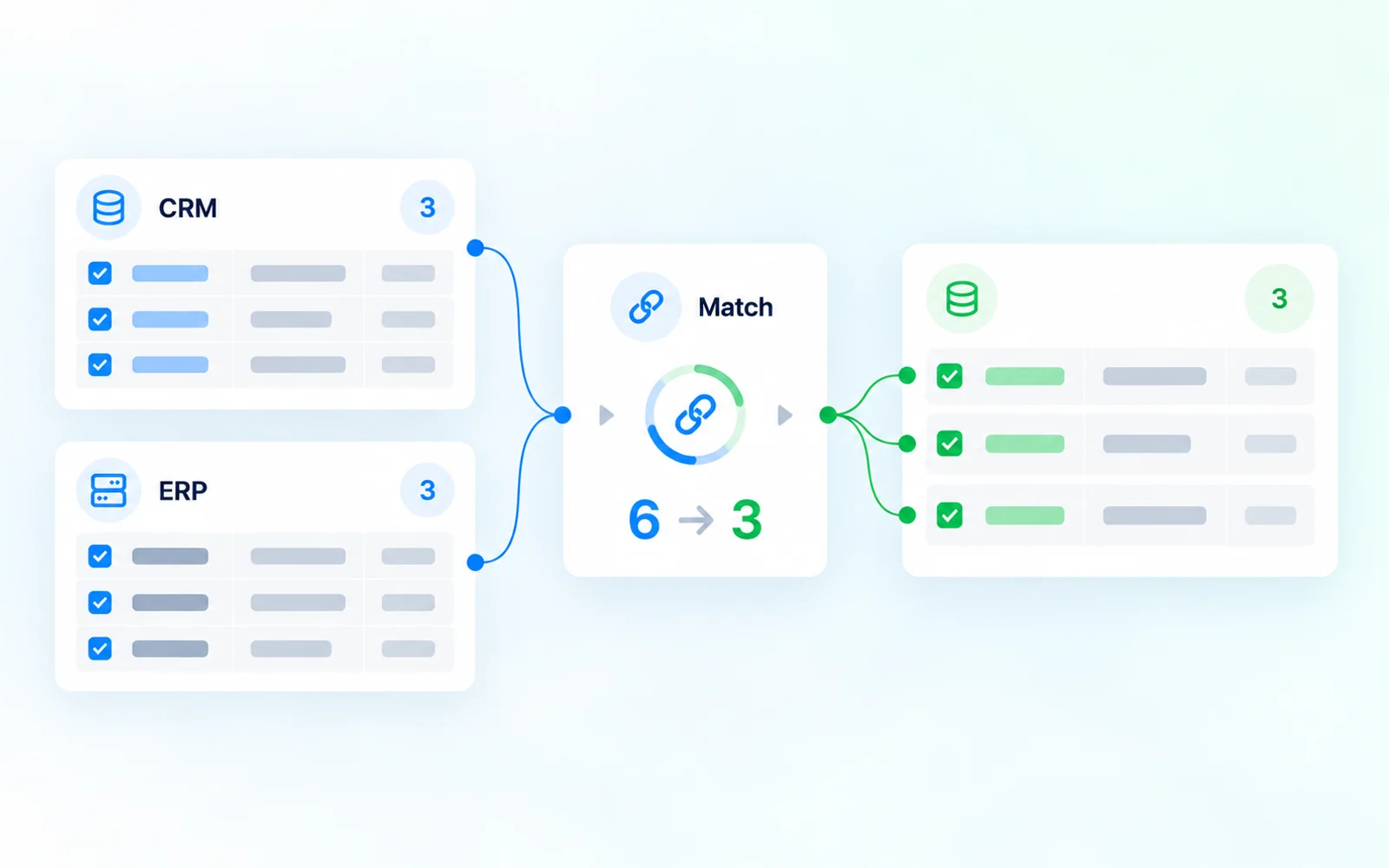
Many organisations have several datasets that essentially cover the same subject.
Consider product files from different suppliers.
Customer data from multiple systems.
Or market data from a variety of public sources.
In practice, however, this data often differs just enough to prevent it from being connected automatically.
A product has different item numbers.
A company name is written differently.
An address is incomplete.
Or the same organisation appears more than once.
This creates fragmented information and makes comparison, analysis, and automation difficult.
Scrape IT helps organisations automatically connect, validate, and enrich datasets using data matching.
This creates one reliable information picture that analyses, dashboards, and business processes can trust.
Organisations collect more and more data.
But data from different sources rarely aligns one-to-one.
Examples include:
Without data matching, these datasets remain separate information sources.
Automatically connecting data creates one consistent dataset that organisations can use for more reliable analysis and automation.
The quality of analyses is not determined by the amount of data. It is determined by how accurately data is connected. Reliable information only emerges when datasets recognise the same companies, products, or locations.
The same product can have a different name, item code, or description at different suppliers. This makes automatic comparison almost impossible.
Organisations are often registered in different ways. Abbreviations, typing errors, or variations in spelling cause the same organisation to appear multiple times.
Data from different systems often uses different structures, field names, or identifiers. As a result, data cannot be combined without additional processing.
Many organisations check datasets manually before analysis can be performed. As datasets grow, this becomes increasingly time-consuming and prone to error.
Good data matching involves more than comparing two spreadsheets.
The challenge is to automatically recognise, connect, and enrich different data sources so that one consistent dataset is created.
Scrape IT combines intelligent matching techniques with validation and data enrichment to reliably connect companies, products, locations, and other entities.
The solution is used for applications including:
Product information from different suppliers or data sources is connected automatically. This enables organisations to compare products objectively, regardless of differences in product names, item codes, or descriptions. Applications include:
Companies are recognised automatically, even when names or details do not match exactly. This creates one complete company view across multiple data sources.
Locations from different data sources are connected automatically. Examples include branches, points of sale, charging locations, and properties.
Duplicate records are recognised and merged automatically. This improves data quality and gives organisations one consistent source of information.
Automatically connect companies, products, and locations from different data sources and always work with one reliable dataset.
Many organisations work with data from different sources every day.
Some of it comes from the CRM.
Another part comes from an ERP system.
External datasets are also used, or information is collected from public sources.
On paper, these datasets concern the same companies, products, or locations.
In practice, however, the data differs just enough to prevent it from being connected automatically.
Data matching changes this way of working.
Instead of:
Which dataset is correct?
the question becomes:
How do we combine all available information into one reliable dataset?
This gives employees one consistent dataset that analyses, dashboards, and business processes can always rely on.
Automatically connecting datasets creates a more complete and reliable information picture.
Common applications include:
This enables organisations to achieve benefits including:
Compare products from different suppliers or competitors using reliable product matching.
Prevent duplicate customer records and work with one complete customer view.
Connect supplier data from different systems into one reliable dataset.
Work with consistent datasets for reports, analyses, and data models.
Improve the quality of business data and create one central source of truth.
Organisations often already have all the information needed to make better decisions.
The challenge is that this information is distributed across different systems and data sources.
Automatically connecting companies, products, locations, and other entities creates one reliable information picture that analyses, dashboards, and business processes can trust.
This makes data matching more than a technical step within a data process.
It forms the foundation for data intelligence, enabling organisations to work with consistent, complete, and reliable data that can be used directly for analysis, automation, and decision-making.
Data matching is the automatic recognition and connection of the same companies, products, locations, or other entities across different data sources. This creates one consistent dataset that organisations can use for more reliable analysis and automation.
Data from different systems often does not align one-to-one. Automatically connecting datasets creates a more complete information picture, improves data quality, and makes analyses more reliable.
Depending on your application, data including products, companies, customers, suppliers, locations, addresses, objects, and other unique entities can be connected.
Data matching compares different characteristics such as names, product codes, addresses, or other identifying data. Based on these characteristics, records are automatically connected into one consistent dataset.
No. Data matching is valuable for both small and large datasets. Its added value generally increases as the number of data sources grows.
Yes. Many organisations combine internal data with public data sources or market information to build a more complete and reliable information picture.
This solution is used by organisations including retailers, wholesalers, manufacturers, e-commerce companies, financial service providers, and organisations with multiple data sources.
Matched data can be delivered in almost any required format or integrated directly with existing systems. Options include APIs, dashboards, CSV, Excel, JSON, XML or Parquet, Power BI, MCP for direct integration with AI applications, EDI, (S)FTP, email alerts, and direct integration with proprietary systems. In short, almost any preferred form of data delivery or integration is possible.
Yes. Many organisations combine data matching with MCP AI data integration for AI applications, dashboarding for real-time analysis, and intelligence solutions such as price monitoring and market intelligence and competitor analysis.
Data matching focuses on recognising and connecting data from different sources to create one consistent dataset. CRM enrichment focuses on supplementing and updating customer and prospect data within a CRM system. Many organisations combine both solutions to improve both data quality and the completeness of their CRM.
Discuss which internal and external data sources you want to connect and how current information should become available to dashboards, AI, and business processes.