
01
CRM data quickly becomes outdated
Contacts change, companies grow, websites are updated and new locations open. CRM data quickly loses value, leaving sales teams without current prospect information.
Most sales teams do not lack prospects. They lack insight into which organisations offer the greatest commercial opportunity today. New sales opportunities emerge every day. Companies invest, expand, hire, open new locations, develop products or enter new markets. These are signals that help sales teams identify their most promising accounts. Scrape IT turns current company information and commercial signals into actionable sales intelligence. Not to approach more companies, but to reach the right organisations at the right time and for the right reason.
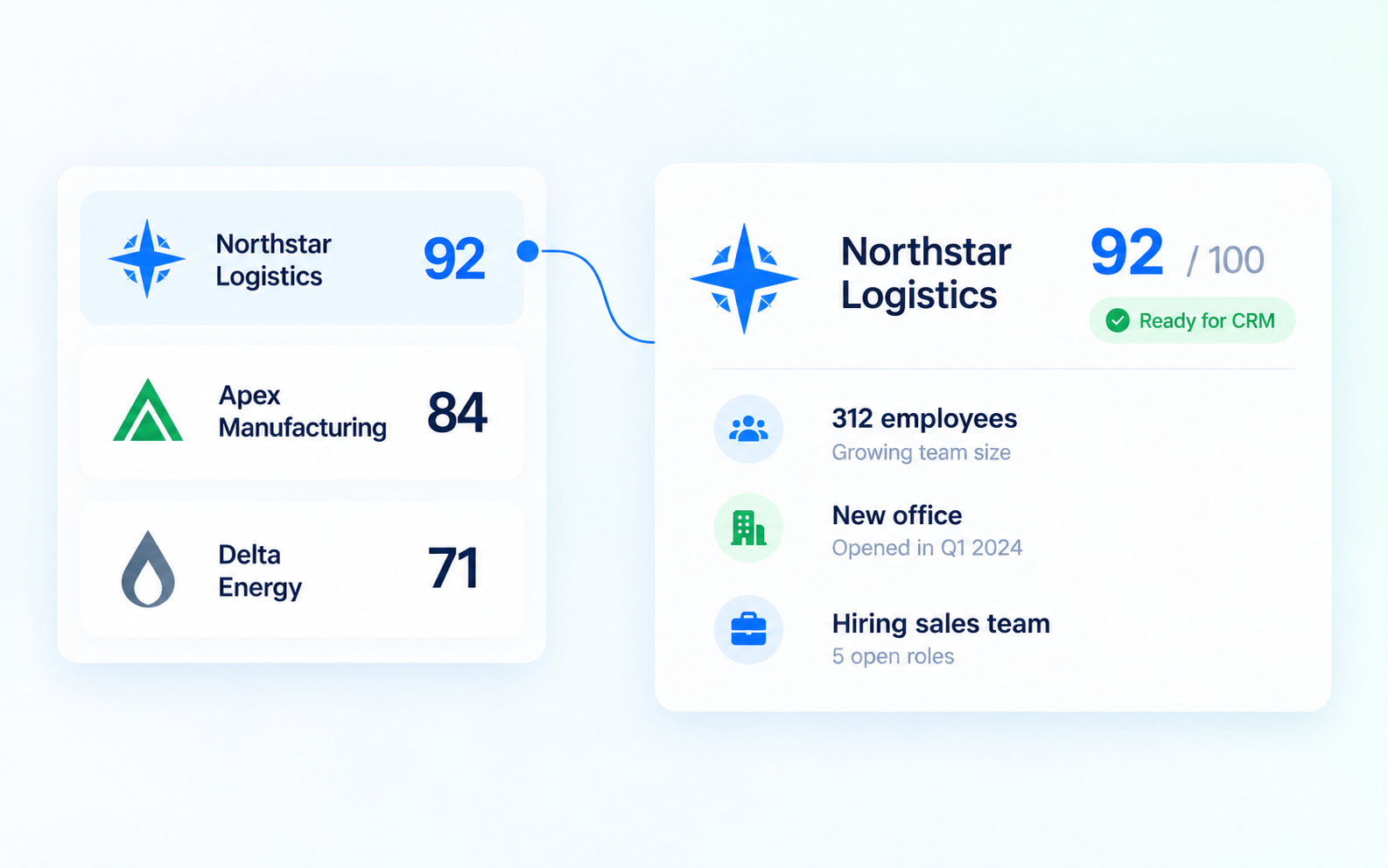
A traditional prospect list is only a snapshot in time.
Organisations are constantly changing. Contacts change roles, companies grow, new locations open and commercial priorities shift.
As a result, prospect data becomes outdated faster than many organisations realise.
A lead list that was current a few months ago may already contain incorrect details or miss companies that have since become relevant.
Sales and marketing teams waste time checking, enriching and updating prospect details before they can start outreach.
That is why lead generation is shifting from static company lists to continuously updated sales intelligence.
This is not only because data ages quickly, but also because relevant outreach matters more than approaching as many organisations as possible.
Rules and regulations around marketing and outreach continue to evolve. Organisations also increasingly expect commercial communications to be relevant, personal and well-founded.
Mass outreach to random companies with generic messages delivers less and less, and no longer fits how modern sales teams work.
The greatest opportunity is not to collect more prospects, but to identify organisations for which your solution is genuinely relevant right now.
Using current company information and commercial signals helps sales teams prioritise accounts, have more relevant conversations and use their commercial capacity more effectively.
Scrape IT collects information only from public sources. Organisations remain responsible for using this data lawfully and complying with applicable marketing and outreach regulations.
Successful sales organisations do not stand out because they approach more companies. They stand out because they recognise the right organisations at the right time. Combining current commercial signals with reliable company information shifts sales from broad outreach to focused account prioritisation. This leads to more relevant conversations, more efficient use of sales capacity and higher conversion rates.
Contacts change, companies grow, websites are updated and new locations open. CRM data quickly loses value, leaving sales teams without current prospect information.
A list of company names is not a useful sales list on its own. Without insight into current developments, it is hard to tell which organisations are genuinely interesting right now. Adding commercial signals to prospect data creates a priority list that helps sales teams work more effectively.
Organisations that invest, expand or develop new activities often show commercial signals early. When these signals are not tracked, valuable sales opportunities are missed.
When only basic details are available, there is no context for contacting a prospect at the right moment. Outreach then feels generic and is less relevant to the organisation's current situation.
Sales teams spend much of their time on prospects with little commercial potential at that moment. Better account prioritisation creates more room to focus on organisations that are ready for a conversation.
Effective lead generation does not start with collecting as many companies as possible.
It starts by recognising the organisations with the greatest commercial opportunity right now.
Scrape IT collects, validates and enriches company information from public sources, combining it with current commercial signals.
This creates sales intelligence that helps sales teams quickly decide which accounts deserve priority.
The focus is not on generating as many leads as possible. It is on relevant outreach, better timing and higher conversion potential.
These insights can be used for:
An effective prospect list starts with the right target audience and a relevant reason to make contact, not with as many companies as possible.
More organisations are combining audience criteria with commercial signals such as growth, new vacancies, business expansion, new locations and investment.
Scrape IT builds current B2B datasets using criteria such as industry, location, company size, services and other company characteristics. These datasets can be enriched with company details, contact information and additional commercial insights.
Sales and marketing teams get a relevant, up-to-date prospect file that helps them identify opportunities sooner. Many organisations combine B2B lead generation with CRM enrichment to keep customer and prospect information current.
Explore this solutionJob vacancies are among the strongest commercial signals an organisation can give. Active recruitment often points to growth, expansion or new investment.
That makes vacancy data valuable for sales. Scrape IT monitors vacancies from public sources and turns them into useful sales intelligence.
Sales teams can spot organisations that may be open to new suppliers, products or services sooner. Many organisations combine job monitoring with market intelligence and competitor analysis to prioritise opportunities in their market.
Explore this solutionA CRM system is only valuable when its information is current and complete. Organisations change constantly: contacts move roles, companies grow, new locations open and company details change.
When these changes are not updated automatically, sales teams lose valuable time checking records and spot commercial opportunities later.
Automatically enriching CRM data gives sales and marketing teams a current view of customers and prospects.
This helps sales teams decide which accounts deserve priority and start conversations with the right information. Many organisations combine CRM enrichment with data integration and AI to make current customer information available in dashboards, reports and other business processes.
Many organisations still approach entire prospect lists with the same message. In practice, this delivers less and less.
Adding commercial signals to prospect data creates a different way of working.
Instead of asking:
Which companies fit my target audience?
you can see:
Which organisations have a good reason to speak with us right now?
For example, organisations that:
This creates more than a prospect list. It creates a priority list that helps sales teams focus their time on organisations with the greatest commercial opportunity.
Combining current company information with commercial signals helps sales teams focus their time and attention on accounts with the greatest commercial potential.
Common applications include:
Organisations can achieve:
Compiling a list of companies is easy today.
The real value comes when sales teams know which organisations offer the greatest commercial opportunity today and why now is the right time to make contact.
Combining prospect data with current commercial signals shows which accounts deserve priority and what makes a first conversation relevant.
A traditional prospect list becomes more than a collection of company details.
It becomes sales intelligence that helps organisations sell with focus, have more relevant conversations and use their commercial capacity more effectively.
B2B lead generation is the process of identifying companies that may be interested in your products or services. Current company information and commercial signals help organisations focus on the most promising prospects.
Sales intelligence is the collection and analysis of current company information and commercial signals to identify sales opportunities more effectively. It helps sales teams prioritise prospects and make more relevant approaches.
Companies change constantly. New locations, vacancies, investments and other developments quickly make static prospect lists outdated. Current company data helps identify more relevant sales opportunities.
Depending on your target audience, signals can include vacancies, business expansion, new locations, investments, product launches and other public company developments.
Sales intelligence suits organisations active in B2B sales that want to find new customers more efficiently. Sales, marketing and business development teams use it widely.
Lead generation focuses on finding new potential customers. CRM enrichment automatically adds current company information to existing customer and prospect records, keeping your CRM complete and up to date.
This depends on the data sources used. Company details and commercial signals can be updated daily or more often, depending on the application.
Yes. Current company information and commercial signals can be connected to existing CRM systems, giving sales and marketing teams the latest information for outreach and account management.
Focusing on companies that show commercial signals makes conversations more relevant and uses sales capacity more efficiently. This often leads to a better chance of conversion.
Companies often show commercial signals before actively looking for new suppliers. Growth, vacancies, investments, new locations and product launches are examples. Monitoring these signals helps sales teams respond to opportunities sooner.
Discuss how current company information and commercial signals can help your sales and marketing teams recognise opportunities sooner.