
01
Important developments are missed
Thousands of news articles are published every day. This makes it almost impossible to manually track relevant developments surrounding customers, suppliers, or partners.
Automatically monitor company news, reorganisations, acquisitions, and other business signals. Receive immediate insight into relevant developments.
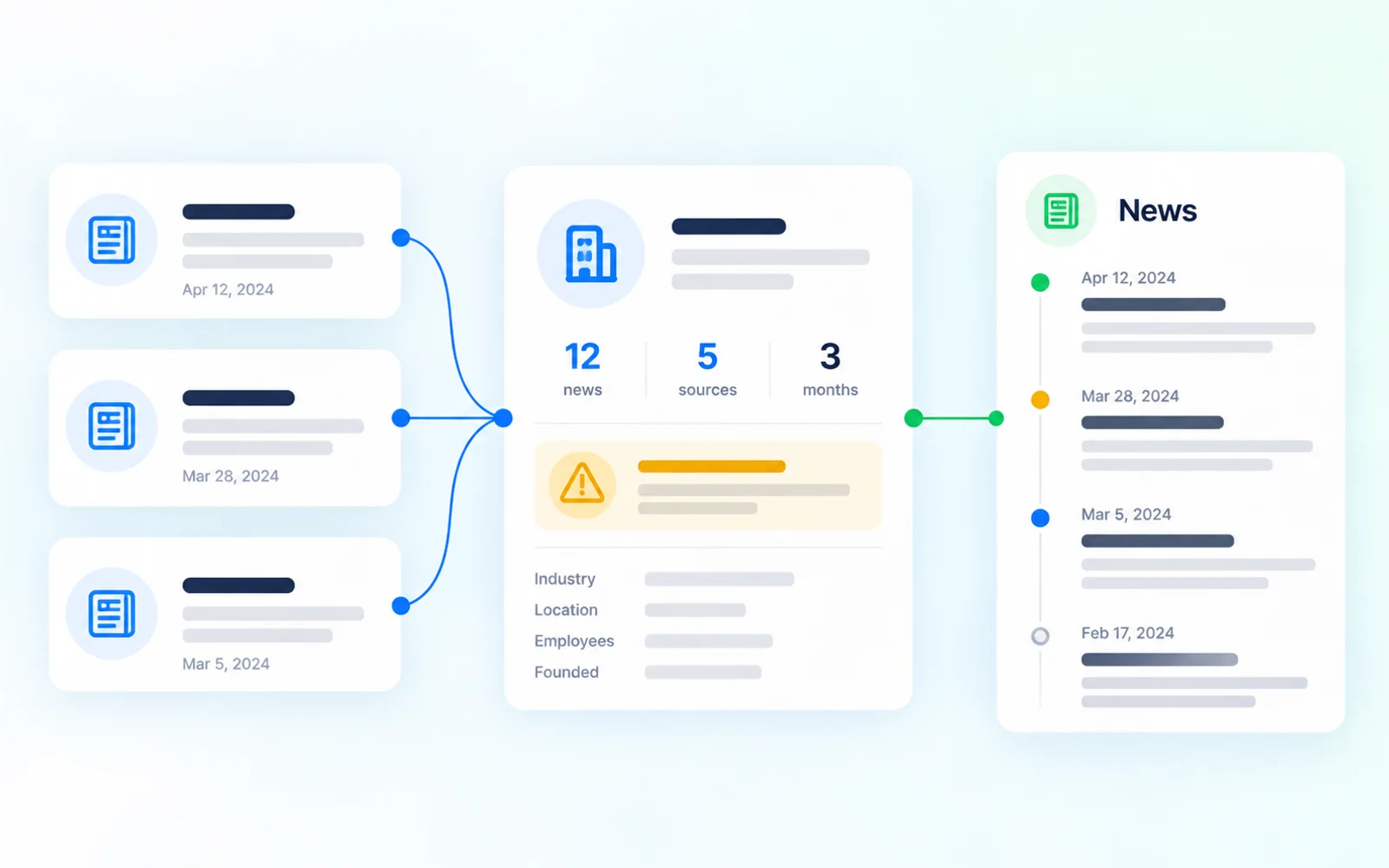
Not every important development becomes visible in a company register.
The first signals often appear much earlier.
A reorganisation.
A major investment.
An acquisition.
A legal proceeding.
Or negative reporting that could affect an organisation's continuity.
For organisations that depend on customers, suppliers, or business partners, manually tracking all this public information is almost impossible.
Important developments are therefore often only noticed after they have already affected the relationship.
Scrape IT automates business news and company-signal monitoring by continuously monitoring public news sources, trade media, and other public publications and making relevant signals immediately available through dashboards, APIs, and automatic alerts.
This ensures your organisation always has current context about important business relationships.
Companies do not only change in official registrations.
Many developments become visible earlier through public reporting.
Examples include:
These developments provide valuable context about how organisations are evolving.
Automatically monitoring business news means employees no longer need to manually follow dozens of news websites or trade publications.
A news article is rarely a risk in itself. Its value lies in the context. Automatically collecting relevant company signals creates a more complete picture of business relationships and allows developments to be recognised sooner.
Thousands of news articles are published every day. This makes it almost impossible to manually track relevant developments surrounding customers, suppliers, or partners.
Relevant company signals appear in many different places. Examples include:
Without central monitoring, there is no complete overview.
Many organisations only search for news when there is a direct reason to do so. As a result, important developments are often discovered too late.
A change within an organisation becomes much more meaningful when combined with current news developments. Automatically collecting relevant reporting creates more context for account management, supplier management, and risk assessment.
Good news monitoring involves more than collecting news articles.
The challenge is to automatically recognise relevant public reporting, connect it to your customer, supplier, or business-relationship file, and show only the signals relevant to your organisation.
Scrape IT automates this entire process.
Business news and public signals are automatically collected, filtered, and made available through dashboards, APIs, or automatic alerts.
The information is used for applications including:
We monitor news about organisations including:
This keeps your organisation continuously informed about relevant developments.
Public reporting about legal developments can provide important context. We monitor information including:
Changes within organisations can also be tracked automatically. Examples include:
This creates a more complete picture of how organisations are developing.
Not every news article requires action. But negative reporting can provide a reason to assess a business relationship more closely. Depending on your requirements, relevant negative signals can be recognised and reported automatically.
Automatically track relevant news developments and public company signals from one central dashboard and receive immediate alerts about organisations important to your business.
Many organisations only follow important customers or suppliers when there is an immediate reason to do so.
Relevant developments therefore often remain unnoticed.
Business news and company-signal monitoring changes this way of working.
Instead of:
Has anything happened recently at this organisation?
the question becomes:
Which relevant news developments were published today about my customers, suppliers, or other business relationships?
Account managers, procurement, finance, and risk teams therefore always have current context during commercial and operational decision-making.
Automatically monitoring business news provides faster insight into developments that can affect business relationships.
Common applications include:
This enables organisations to achieve benefits including:
Stay informed about important developments at customers and have better-informed conversations.
Follow news about suppliers and gain faster insight into developments that could affect the relationship.
Use current company signals as additional context within existing risk and assessment processes.
Follow relevant public reporting about organisations within your business network.
Automatically receive an overview of important developments within your customer, supplier, or partner network.
Public reporting often reveals more than an individual news article.
When news, trade media, and other public company signals are brought together automatically, they provide insight into developments surrounding customers, suppliers, and other business relationships.
Organisations therefore have not only separate news articles but current context that supports commercial, operational, and strategic decisions.
Public company signals become part of Risk Intelligence, enabling organisations to recognise developments earlier, assess relationships more effectively, and respond more quickly to changes within their business network.
Business news and company-signal monitoring automatically tracks public reporting about organisations. This includes news articles, trade media, press releases, and other public publications that provide insight into developments at customers, suppliers, and business partners.
Important developments often become visible in public reporting before they appear in company registers or financial reports. Automatically monitoring these signals gives your organisation current information sooner and provides more context about business relationships.
Depending on your requirements, we monitor news reports, trade media, press releases, reorganisations, acquisitions, investments, legal developments, strategic partnerships, and negative reporting.
Yes. Many organisations provide their own customer, supplier, or business-relationship file. We only monitor the organisations relevant to your operations.
Yes. You can automatically receive an alert as soon as a relevant news development or important business signal is published about an organisation in your monitoring file.
This depends on the sources and your requirements. New publications can be processed automatically as soon as they become publicly available, making relevant developments visible quickly.
This solution is used by teams including account management, procurement, finance, risk and compliance, senior leadership, and professional service providers.
Business signals can be delivered in almost any required format or integrated directly with existing systems. Options include APIs, dashboards, CSV, Excel, JSON, XML or Parquet, Power BI, MCP for direct integration with AI applications, EDI, (S)FTP, email alerts, and direct integration with proprietary systems. In short, almost any preferred form of data delivery or integration is possible.
Yes. Many organisations combine this solution with bankruptcy monitoring for financial developments and company registry and company-change monitoring for changes in company registrations. Together, these solutions create a more complete view of business relationships.
Business news and company-signal monitoring focuses on developments surrounding individual organisations, such as customers, suppliers, or business partners. Market intelligence and competitor analysis focuses on broader market developments, competitors, innovations, assortments, and trends across an entire market. Many organisations combine both solutions to continuously monitor individual organisations and the broader market.
Discuss which customers, suppliers, or business relationships you want to monitor automatically and how those signals should reach your processes.